Last chance to earn 100,000 miles: Capital One Venture X's highest offer in 4 years ends soon

The Capital One Venture X Rewards Credit Card stands tall in the travel credit card market. This is thanks to its straightforward benefits, ability to earn valuable Capital One miles and annual fee of $395, modest compared to its premium counterparts.

If you've been eyeing this rewards card, now is a fantastic time to apply. That's because the card is offering its highest welcome bonus since its launch in 2021. The only time this card has had a limited-time welcome bonus was during the first four months after it debuted.

But the offer ends on Jan. 5, 2026, so you'll want to act soon to secure it.

Let's dive into the Venture X's bonus and benefits to help you decide whether now is the time to add the card to your wallet.


Current Capital One Venture X offer

New Venture X applicants can earn 100,000 miles after spending $10,000 on purchases in the first six months of account opening. This is your last chance to earn this bonus, as it ends on Jan. 5, 2026.

According to TPG's December 2025 valuations, this bonus is worth $1,850.

Venture X card art
THE POINTS GUY

Capital One miles are most valuable when you leverage one of the issuer's 15-plus transfer partners. However, cardholders also have the option to redeem at a fixed rate of 1 cent per point to cover recent travel purchases on the card or make bookings through the Capital One Travel portal. This bonus is worth a respectable $1,000 if you redeem it this way.

How does this compare to past offers?

Outside of the Venture X's November 2021 launch, this is the only elevated offer we've seen in the card's history. The Venture X offered the same 100,000-mile offer from November 2021 to March 2022. Otherwise, it has never strayed from its standard 75,000-mile offer (not currently available).

This 100,000-mile offer hasn’t been available in four years, making now a great time to apply. The offer expires soon, so be sure to apply by Jan. 5, 2026.

Application rules and restrictions

Capital One has imposed a 48-month family rule across its lineup of Venture cards, including the Capital One VentureOne Rewards Credit Card and the Capital One Venture Rewards Credit Card.

This new Venture family rule restricts you from moving ‘down’ the Venture card family (in terms of annual fees), meaning if you already have the Venture X and earned the bonus in the last 48 months, you won't be approved for the VentureOne ($0 annual fee) or Venture ($95 annual fee). So, that's something to keep in mind if you want to pick up one of these two lower-tier cards in the future.

Additionally, if you've opened the Venture X and received its bonus in the last 48 months, you won't be eligible for this current bonus.

Capital One's other application restrictions require you to wait six months between approvals for new Capital One cards, including both personal and business cards.

Related: 6 things to do when you get the Capital One Venture X

Why you should apply for the Venture X

The Venture X provides several benefits for frequent travelers to enjoy. Key perks include:

  • Anniversary bonus: The card pays 10,000 bonus miles on your account anniversary, starting on your first anniversary. As of December 2025, TPG values those 10,000 miles at up to $185 when utilized with Capital One’s transfer partners.
  • Annual travel credit: Cardholders will receive a $300 annual credit for bookings made through Capital One Travel.
  • Authorized users: Additional authorized users can be added at no charge. However, beginning Feb. 1, 2026, each authorized user will cost $125 annually to retain Capital One and Priority Pass lounge access.
  • Global Entry or TSA PreCheck: Cardholders receive up to $120 in statement credits for either TSA PreCheck or Global Entry.
  • Lounge access: Cardholders, authorized users and up to two guests per visit get complimentary access to Capital One lounges and more than 1,300 Priority Pass lounges until Feb. 1, 2026. After this date, you'll be required to pay for guest access to both types of lounges.
  • Luxury hotel perks: The Capital One Premier Collection offers free breakfast, room upgrades and other perks at participating hotels and resorts. Cardholders can also access Capital One’s lower-tier Lifestyle Collection.
  • Stacking car rental perks: Cardholders can stack car rental perks with Hertz.*

*Upon enrollment, accessible through the Capital One website or mobile app, eligible cardholders will remain at that status level through the duration of the offer. Please note, enrolling through the normal Hertz Gold Plus Rewards enrollment process (e.g. at Hertz.com) will not automatically detect a cardholder as being eligible for the program and cardholders will not be automatically upgraded to the applicable status tier. Additional terms apply.

Woman using her laptop outdoors
OSCAR WONG/GETTY IMAGES

On top of these benefits, the Venture X makes it easy to earn Capital One miles at competitive rates:

  • 10 miles per dollar spent on hotels and rental cars booked through Capital One Travel
  • 5 miles per dollar spent on flights and vacation rentals booked through Capital One Travel
  • 2 miles per dollar spent on all other purchases

If you maximize the full value of just two of the Venture X's annual perks — the $300 travel credit and 10,000 bonus points — you will effectively recoup your $395 annual fee. That's because TPG's December 2025 valuations place the bonus points at $185. When you add the value of the $300 credit to this, you reach a total annual value of $485.

Related: Cashing in Capital One miles? How to get the maximum value when redeeming miles

Bottom line

The Venture X is providing 100,000 miles in its first elevated offer since launch, which makes now a great time to apply if you're eligible for the bonus.

With the offer expiring soon, you'll want to apply now so you don't miss out. The bonus ends on Jan. 5, 2026.

This card can be a great option for many travelers, and the card will likely become more compelling over time as Capital One continues to invest in its rewards program and expand its lounge network.

To learn more, read our full review of the Venture X.


Learn more: Capital One Venture X


For Capital One products listed on this page, some of the benefits may be provided by Visa® or Mastercard® and may vary by product. See the respective Guide to Benefits for details, as terms and exclusions apply.

Editorial disclaimer: Opinions expressed here are the author’s alone, not those of any bank, credit card issuer, airline or hotel chain, and have not been reviewed, approved or otherwise endorsed by any of these entities.



from The Points Guy Articles https://ift.tt/4ujDGdQ

How to transfer Chase Ultimate Rewards points to JetBlue TrueBlue

Chase Ultimate Rewards points are one of the most valuable rewards currencies out there, in part because you can transfer them to a variety of hotel and airline partner programs, including JetBlue TrueBlue. Transferring points to partners can often unlock great award deals and help you maximize the value of your points.

Read on to learn how to transfer your Chase points to JetBlue, and when it makes sense to do so.

Related: Your guide to the Chase Ultimate Rewards airline and hotel transfer partners

Can you transfer Chase points to JetBlue?

Woman using credit card to shop online
WESTEND61/GETTY IMAGES

Yes, if you have certain Chase cards that earn Ultimate Rewards points, you can transfer them to your JetBlue TrueBlue account. Those cards include the following:

However, if you also have another Chase card that earns Ultimate Rewards points in the form of cash back, such as the Chase Freedom Flex® (see rates and fees) or Chase Freedom Unlimited® (see rates and fees), you can combine the points you earn with it with your credit card account that earns fully transferable Ultimate Rewards points and then transfer them that way.

The information for the Ink Business Preferred has been collected independently by The Points Guy. The card details on this page have not been reviewed or provided by the card issuer.

Related: No-annual-fee credit cards that earn transferable rewards

Chase-to-JetBlue transfer ratio

JetBlue planes
ROMAN TIRASPOLSKY/SHUTTERSTOCK

Chase Ultimate Rewards points transfer to JetBlue at a ratio of 1:1. However, Chase runs occasional transfer bonuses that can give you an even better ratio. These transfer bonuses are sporadic, but if you find one that aligns with your travel plans, you can save thousands of points. Transfers tend to be instantaneous, but may take up to several business days.

Related: JetBlue Plus Card vs. JetBlue Premier Card: Should you go mid-tier or premium?

How do you transfer Chase points to JetBlue?

One of the great things about transferable points is that you can redeem them for award flights with airlines you've never flown or accrued points or miles with before. If that's the case, you'll need to set up a JetBlue TrueBlue account before you can transfer your Chase points to JetBlue.

Head to JetBlue’s site to create an account for free. Then, visit your Chase portal and go into your Ultimate Rewards account. Click "Travel" on the top toolbar, and choose "Transfer points to partners."

CHASE

On the next screen, you'll see a list of Chase's travel partners, with any available transfer bonuses noted at the top. Scroll down, and click on the JetBlue option.

This will take you to a page with some rules about transferring your points to JetBlue; for instance, points transferred via the Chase portal are not eligible for earning JetBlue Mosaic status.

Chase JetBlue transfer fine print
CHASE

After reviewing the fine print, click the blue "Transfer Points" button at the bottom right.

On the following page, you'll need to enter your JetBlue TrueBlue number if you have not previously logged it, or just confirm it if you have. Chase also allows you to transfer points to one authorized user on your Chase account, so you could enter their TrueBlue number instead. Once you complete this step, click "Next."

Chase JetBlue transfer step 1
CHASE

Then, enter the number of points you want to transfer. This must be a multiple of 1,000, so you may need to transfer a few more points than required for your redemption.

Chase JetBlue transfer step 2
CHASE

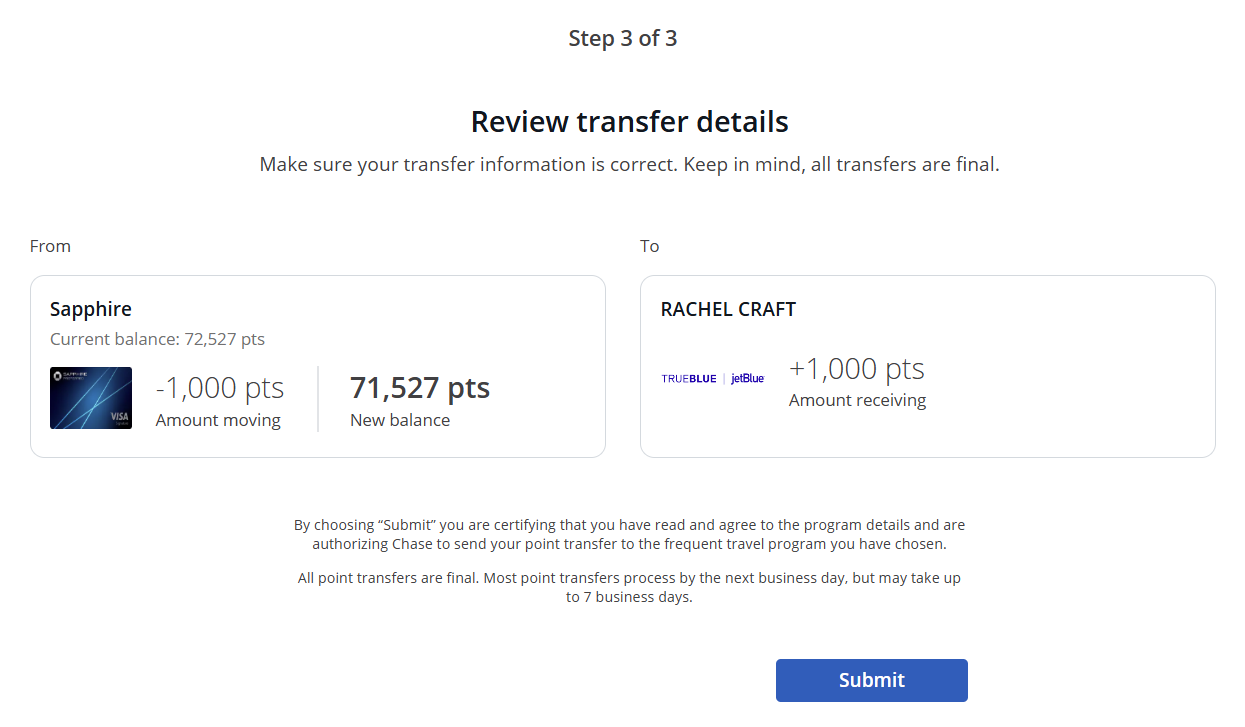
The next page will give you a chance to review your information before processing the transfer. Remember that transfers are irreversible, so be sure you have entered the correct number of points you want to transfer before you hit "Submit." An innocent typo could cause you to transfer 100,000 hard-earned points when you meant to transfer only 10,000. It's also a good idea to double-check the spelling of your name and your TrueBlue number.

Chase JetBlue transfer step 3
CHASE

If you're ready to complete the transfer, click "Submit" and wait for your points to hit your JetBlue account.

According to Chase's site, "Most point transfers process by the next business day, but may take up to 7 business days." However, TPG's tests have shown that most transfers to JetBlue happen instantly. That means you could be booking your award flight mere minutes after transferring your Chase points.

Related: Blue Sky alliance: You can now redeem JetBlue points for United flights

When should you transfer Chase points to JetBlue?

JetBlue prices both cash and award rates dynamically, so the more a flight costs in dollars, the more it will cost in points. As a result, you can usually expect to get right around TPG's December 2025 valuation of 1.45 cents per point on JetBlue award flights.

Before you decide to book an award flight, search for the same flight on the Chase Travel℠ portal. You may be able to get a better value, depending on which credit card you have and whether the flight is eligible for Chase Points Boost.

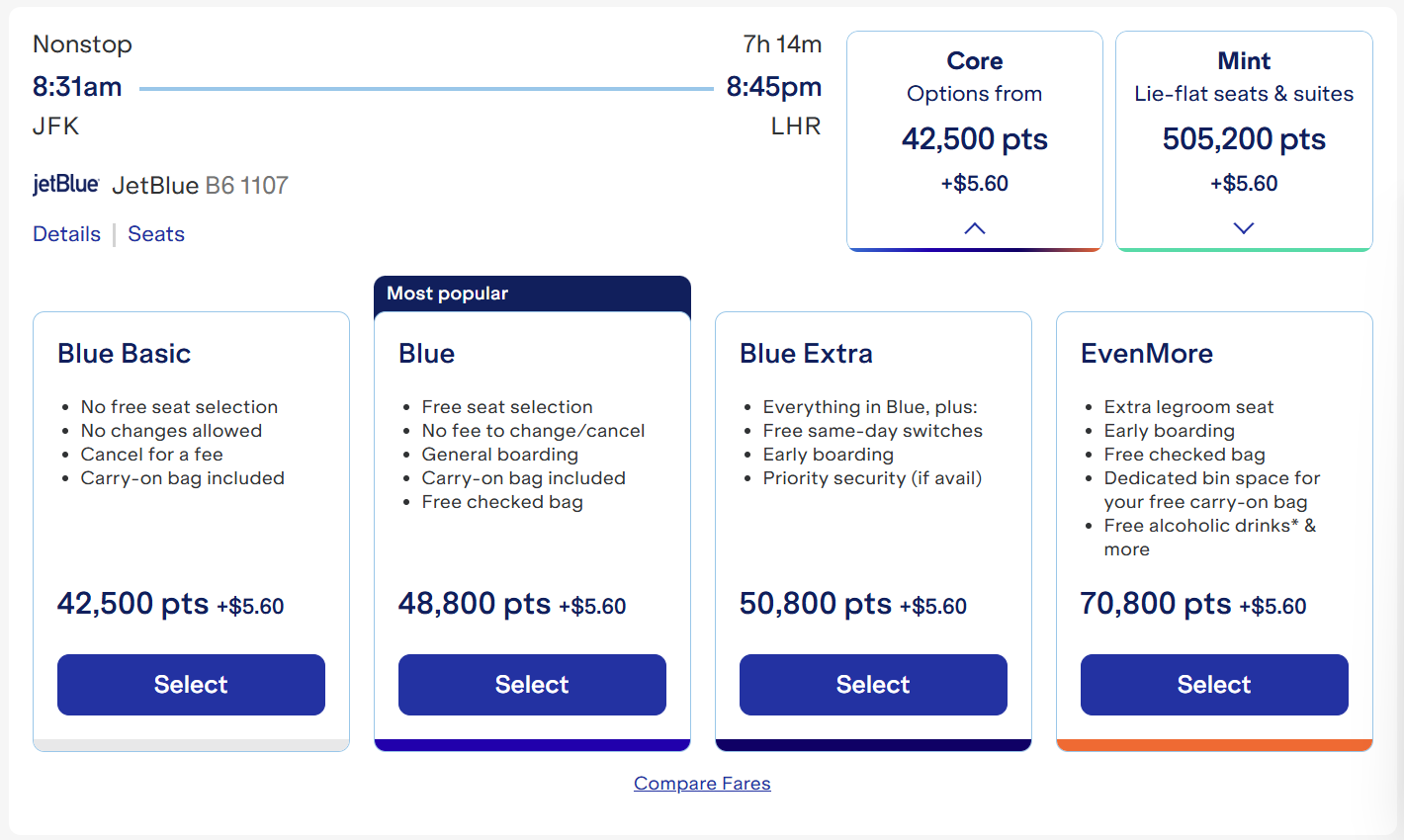
For instance, I could book this nonstop flight from New York to London via JetBlue for 48,800 TrueBlue points in economy (Blue) or 505,200 TrueBlue points in business class (Mint), plus $5.60 in taxes and fees.

JetBlue JFK-LHR points prices
JETBLUE

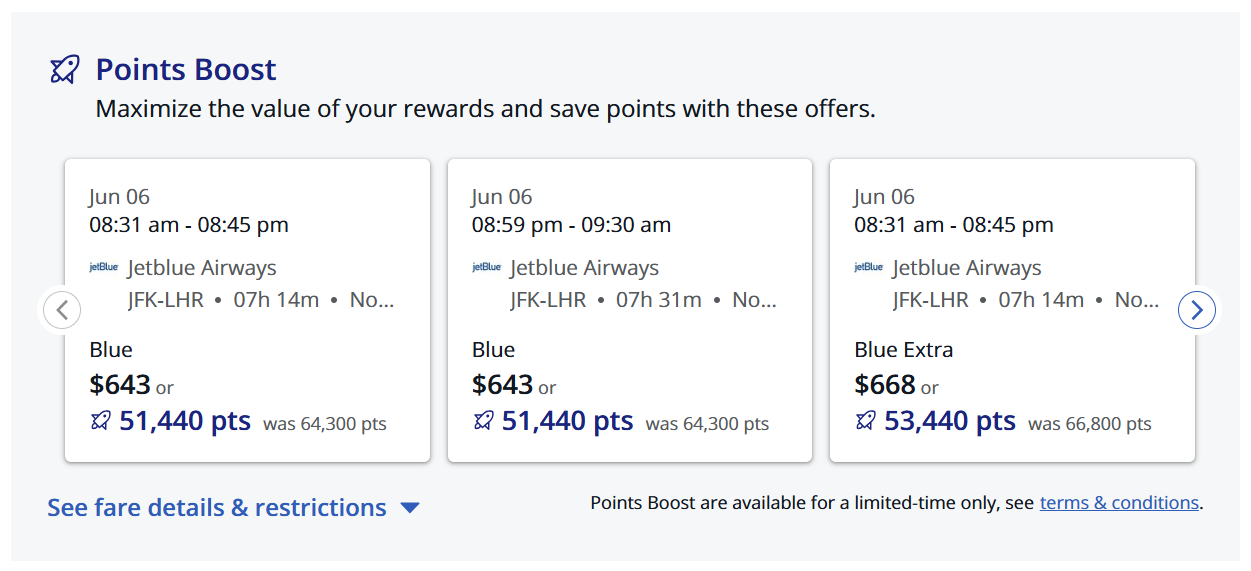
The same Blue fare would cost me 51,440 Chase points if I booked through Chase Travel, so I could save a few thousand points by transferring my points to JetBlue instead.

Chase Travel JetBlue JFK-LHR prices Blue
CHASE TRAVEL

However, the Mint fare costs 319,428 Chase points on Chase Travel — hundreds of thousands of points less than if I booked with JetBlue, though that's still not a deal I would take.

Chase Travel JetBlue JFK-LHR prices Mint
CHASE TRAVEL

If you want to redeem Chase points for a JetBlue flight, be sure to compare prices on JetBlue’s site and Chase Travel to get the best deal.

Related: Why transferable points and miles are worth more than other rewards

Bottom line

Learning how and when to transfer credit card points to airlines and hotels may seem daunting, but the process is actually simple and fast. Once you know how to transfer points, that knowledge will unlock incredible new travel opportunities for years to come.

Just be sure to check prices on Chase Travel and confirm award availability with JetBlue before you transfer points — because transfers are irreversible.

Editorial disclaimer: Opinions expressed here are the author’s alone, not those of any bank, credit card issuer, airline or hotel chain, and have not been reviewed, approved or otherwise endorsed by any of these entities.


from The Points Guy Articles https://ift.tt/sIVPcpD

Why points and miles are a bad long-term investment

It’s easy to think of points and miles as a variant of Monopoly money. They can be easy to throw around and spend nonchalantly.

To other people, though, travel rewards can be easy to hoard. They are a form of currency, after all, and we can become as tight-fisted with our reservoir of points as we are with our hard-earned savings account balances.

However, there is one very important distinction between travel rewards and cash: Unlike most true currencies, which can appreciate if invested wisely, your points and miles are almost guaranteed to lose value over time.

In other words, points and miles are not a great long-term investment. The sooner you can spend them after earning them, the more value you’ll likely receive.

Let’s examine why carrying large balances of points and miles without a plan to use them is a bad strategy. This will help you avoid setting yourself up for disappointment, heartache and a possible loss in net (rewards) worth.

Related: Getting started with points, miles and credit cards to travel

Points and miles devaluations

women holding card
KIWIS/GETTY IMAGES

In recent years, we’ve seen many egregious devaluations from some of our favorite loyalty programs. The general mantra is that transferable rewards are slightly less susceptible to devaluations than rewards in a frequent flyer or hotel program.

Travelers can usually redeem points like these for a fixed rate, at the very least.

But even transferable currencies take a beating now and again. For example:

Devaluations within airline and loyalty programs are unfortunately even more common, with changes including:

What about cash?

Even if you collect and redeem points at a fixed value (which is the case when you have cards like the Capital One Venture Rewards Credit Card, a popular option that lets you offset paid travel at a rate of 1 cent per mile), your rewards still lose value over time.

The U.S. Bureau of Labor Statistics estimated that the inflation rate in the last 12 months rose 3% on major items.

Woman using a credit card at her desk
FRESHSPLASH/GETTY IMAGES

What if you’d opted for cash from the beginning? We like to think of our travel rewards as “free,” but you’re sacrificing money for miles every time you swipe a rewards card instead of a cash-back card.

If you're just letting your hard-earned points and miles sit in your account, it could be more beneficial to opt for a cash-back card so you can immediately see a return on your purchase.

How to redeem your points for maximum value

Woman shopping online
URBAZON/GETTY IMAGES

Redeem your points and miles regularly, and avoid letting your balances grow too high. If you find yourself with hundreds of thousands of points but no trips on the calendar, figure out when your next vacation will be and start planning.

If you’re in the enviable position of earning more points than you can spend, consider sharing your wealth with friends or family members while they still hold their current value.

You might even consider switching to a cash-back credit card. There can be such a thing as having too many points and miles if you can’t spend them fast enough. If you know you can quickly replenish your loyalty accounts, earning cash in the interim is a viable option.

The other great form of protection involves diversification. Currencies that transfer to multiple airline and hotel programs aren’t immune to devaluation, but they still offer far more redemption options if an airline or hotel program undergoes a drastic change.

So, if you don’t already have a card that earns transferable points, now’s the perfect time to consider one.

Related: Airline credit cards vs. travel credit cards: Which are best?

Bottom line

Points and miles can yield a substantial return today and a relatively unremarkable return tomorrow. Simply put, this currency is not suitable for investment, as you are at the mercy of the program, which can and will occasionally increase prices without warning.

So, live by the “earn and burn” philosophy, and get value from your miles before they depreciate. If you haven’t already, review the points you currently have and ensure you can use them before the next wave of inevitable devaluations hits.

Editorial disclaimer: Opinions expressed here are the author’s alone, not those of any bank, credit card issuer, airline or hotel chain, and have not been reviewed, approved or otherwise endorsed by any of these entities.


from The Points Guy Articles https://ift.tt/AHBU9zL

4 reasons I carry 2 premium rewards cards

Before adding the American Express Platinum Card® to my wallet, I analyzed my current credit card setup. The Amex Platinum's $895 annual fee (see rates and fees) was more than enough to prompt a review of my current strategy.

At the time, I had only one card in my wallet with an annual fee exceeding $200: the Capital One Venture X Rewards Credit Card. At $395 each year, the Venture X is among the most affordable cards in the premium market. But was the Venture X worth keeping once I added the Amex Platinum?

After weighing the pros and cons, I decided to keep both of these popular premium travel rewards cards. These are the four factors that influenced my decision.

I earn two valuable currencies

I'm all about collecting transferable points and miles from each of the major issuers. I value both American Express Membership Rewards points and Capital One miles highly. Plus, earning both currencies gives me even more flexibility when making redemptions, as I unlock two sets of transfer partners.

I like to redeem Capital One miles for Delta Air Lines tickets, which I usually book through SkyTeam alliance partner Air France-KLM's Flying Blue. I recently transferred 15,000 miles to Flying Blue to book two one-way domestic Delta flights.

Young Woman hiking at Pointe Helbronner, Mont Blanc
SIMONE CELESTE/GETTY IMAGES

These cards offer fantastic welcome bonuses:

  • Amex Platinum: New cardmembers can find out their offer and may be eligible for as high as 175,000 bonus points after spending $8,000 in the first six months of card membership. (Welcome offers vary, and you may not be eligible for an offer.) Per TPG's December 2025 valuations, this bonus is worth up to $3,500.
  • Venture X: Earn 100,000 bonus miles after spending $10,000 on purchases in the first six months of account opening. TPG's December 2025 valuations deem this offer worth $1,850.

Related: How (and why) you should earn transferable credit card points

I pay with the Venture X — most of the time

I love using my Venture X. It provides at least 2 miles per dollar spent on everything, which is a very solid earning rate.

Woman paying with a credit card
FILADENDRON/GETTY IMAGES

Conversely, my Amex Platinum isn't the best choice for the majority of my spending, since it earns 1 point per dollar spent on most purchases.

However, it comes in clutch when I need to book flights directly or make hotel reservations through American Express Travel®, since it earns 5 points per dollar spent in these categories (on up to $500,000 of these purchases per calendar year, then 1 point per dollar spent).

Related: Why you should get a fixed-rate rewards credit card

I can access more airport lounges

I added the Amex Platinum partly for access to the card's extensive American Express Global Lounge Collection (enrollment required).

I have plenty of choices at most airports I visit. I love the Escape Lounge at my local Greenville-Spartanburg International Airport (GSP) in South Carolina. I expect to visit the Centurion Lounges at Charlotte Douglas International Airport (CLT) and Hartsfield-Jackson Atlanta International Airport (ATL), as I frequently connect through these airports.

Plus, when I pass through ATL on a same-day Delta ticket, I can use up one of my 10 annual visits to the Delta Sky Club.*

*Spending $75,000 or more on my card unlocks unlimited Sky Club visits.

ZACH GRIFF/THE POINTS GUY

The Venture X was my first card with lounge access, and I've had fantastic experiences in their issuer-branded lounges.

Since I've passed through Las Vegas' Harry Reid International Airport (LAS) twice in the past year for concerts, and I often fly through Dallas Fort Worth International Airport (DFW) when I connect on American Airlines, it makes sense for me to keep access to the fantastic Capital One lounges in these two airports.

Related: The do’s and don’ts of visiting an airport lounge

I maximize statement credits

This is a major factor when deciding whether it's worth paying an annual fee.

Amex Platinum statement credits

There is a long list of statement credits offered by the Amex Platinum. This is how I use four of my favorites:

  • Airline fee credit: I receive up to $200 in statement credits per calendar year toward incidental fees on my one selected U.S. airline. I use this when I need to check bags on Delta, since I'll occasionally fly with them but don't have one of their cobranded cards or SkyMiles elite status.
  • Digital entertainment statement credit*: I get $25 off my YouTube TV subscription each month, using up to $300 in statement credits per calendar year toward eligible subscriptions.
  • Dining statement credit*: I spent a $100 quarterly statement credit on date night dinner and cocktails at The 07, a restaurant in my area. I receive up to $400 in statement credits per calendar year at participating U.S. restaurants affiliated with Resy (no reservation required; simply pay with your card at an eligible restaurant).
  • Hotel statement credit: I booked a two-night stay at The Read House, a historic hotel in Chattanooga, Tennessee, for only $236 out of pocket thanks to a biannual $300 credit. I receive up to $600 in statement credits per calendar year toward prepaid stays booked through Amex Travel at Fine Hotels + Resorts or The Hotel Collection properties (split into two $300 biannual statement credits; two-night minimum at The Hotel Collection properties).

*Enrollment required

A room at Longitude 131, a Fine Hotels + Resorts property in Australia.
LONGITUDE 131

Venture X travel credit

The Venture X doesn't have nearly as long a list of credits, but its $300 annual travel credit for bookings made through Capital One Travel lowers the effective annual fee to $95 on its own.

Last year, I used this credit to get $300 off a three-night stay at the Conrad Las Vegas at Resorts World.

Related: Credit card perks and benefits you should be using this month

When it wouldn't make sense

There are a few instances where it wouldn't make sense for me to keep both the Amex Platinum and Venture X.

  • If I didn't have an organized plan to maximize statement credits across both cards, or if I didn't intend to make statement credits a priority.
  • If I didn't plan to visit an Amex or Capital One lounge in the foreseeable future.
  • If I wanted to maintain a simple, one-card setup.

If any of these applied to my situation, I'd downgrade to the $95 annual fee Capital One Venture Rewards Credit Card instead of keeping up with the Venture X.

Related: Why the Capital One Venture X could be the best option for your first premium card

Bottom line

My wallet is unquestionably stronger with both the Amex Platinum and Venture X.

From elevated earning rates to expansive lounge access and high-value statement credits, the perks on these two cards pair exceptionally well. Their strengths fill in each other’s gaps, creating a well-rounded setup that suits many different types of travelers.

I’m confident these cards will meaningfully enhance my upcoming trips — and they already have.

To learn more about either card, read our full reviews of the Amex Platinum and Venture X.


Apply here: American Express Platinum Card

Learn more: Capital One Venture X Rewards Credit Card


For rates and fees of the Amex Platinum, click here.

Editorial disclaimer: Opinions expressed here are the author’s alone, not those of any bank, credit card issuer, airline or hotel chain, and have not been reviewed, approved or otherwise endorsed by any of these entities.


from The Points Guy Articles https://ift.tt/jBOUeIF

Is Disney Cruise Line concierge level worth it? We tested it to find out

When you sail on a Disney cruise, everyone gets access to included food, good service and great entertainment. But there’s a class of cabins that gives guests a bit of extra pixie dust: Disney Cruise Line concierge level.

Disney Cruise Line sits toward the pricier end of the cruising spectrum, even in the most basic of accommodations. But let’s assume you’ve already decided that the cost to cruise with Disney — with the Disney characters, access to an included rotating dining room schedule and evening Broadway-caliber Disney shows — is worth it for you.

As you look at the cabin and amenity options available on Disney cruise ships, you might wonder if Disney Cruise Line’s concierge-level rooms and service are worth the additional premium.

Atrium on a Disney cruise ship
Atrium on a Disney cruise ship. SUMMER HULL/THE POINTS GUY

To answer this question and see what exactly all that extra cash gets you, we sailed in concierge-level rooms on Disney Wonder and Disney Wish. Here’s what we found out about Disney Cruise Line's concierge-level rooms, benefits, service and lounge — and whether the perks are worth the additional cost.

What is Disney Cruise Line's concierge level?

Disney Cruise Line’s concierge level is similar in some ways to a club-level room at a Disney World or Disneyland resort hotel.

You pay more for this type of accommodation in exchange for access to a lounge, more attentive service and additional benefits. But the extras for concierge service on a Disney cruise ship actually go much further than the added benefits of a club room at the Disney parks.

Those who decide to spend the extra cash for a concierge-level room will be spoiled with earlier booking dates for excursions and activities, special onboard meals and offerings, the ability to book cabanas at Disney’s private island before others, early access to the theater in the evening to nab the best seats, and use of a private lounge on the ship.

To access the concierge level on a Disney cruise, you have to book a concierge room type, and the benefits and upgraded service then convey with that cabin type. It’s not an add-on you can tack onto an otherwise nonconcierge cabin.

Cabin types within that concierge class of rooms often start with verandah cabins (i.e., a room with a private balcony) and go up in price and size to include a variety of suites. If you’re already thinking you want to book a suite, you don’t also have to decide about the concierge level; you will automatically get Disney Cruise Line’s concierge service included with your premium accommodations.

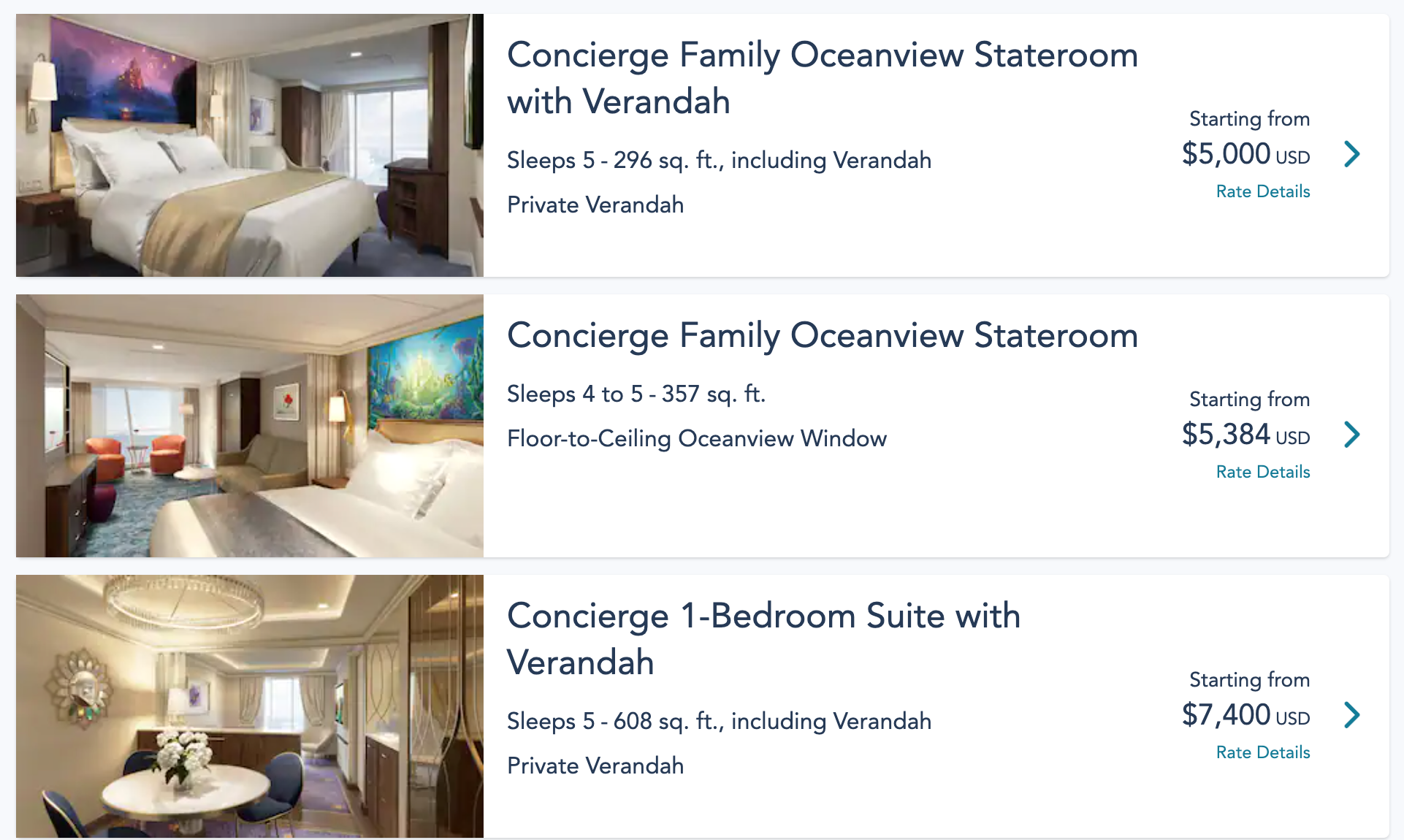
However, if you plan to book a cabin with a balcony, you will need to decide whether you want a room with the standard inclusions or to upgrade to a concierge room with a balcony and all the extra Disney Cruise Line concierge benefits. The difference can be thousands of dollars and access to a slew of additional perks while on the ship.

DISNEY

When I recently priced out Disney Cruise Line concierge rooms, cruise fares for ships departing from the U.S. started at a little under $4,000 for a short sailing for two people during the less busy cruising times. On short sailings from places like Singapore on Disney Adventure and when one of the Disney ships is operating short sailings out of Australia, the starting price for the concierge level can drop a bit lower than that.

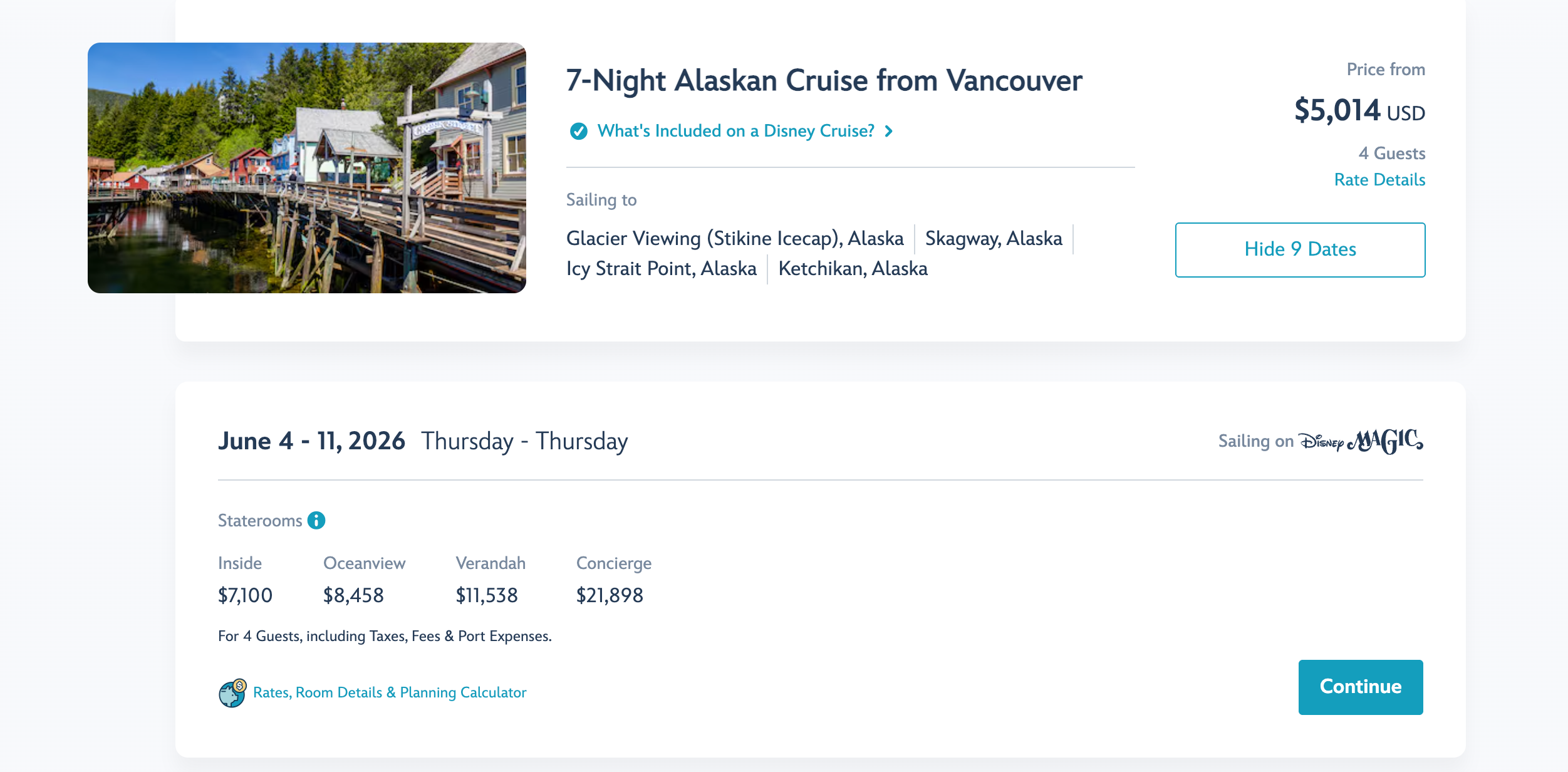
On the flip side, prices go up to tens of thousands of dollars per sailing for concierge level for the larger suites or on longer sailings, such as for a weeklong sailing on the new Disney Treasure or the popular Disney sailings to Alaska.

Concierge lounge on Disney Treasure
Concierge lounge on Disney Treasure. ERICA SILVERSTEIN/THE POINTS GUY

FOR NO-COST ASSISTANCE WITH PLANNING AND BOOKING YOUR NEXT DISNEY VACATION, CHECK OUT TPG’S DISNEY BOOKING PARTNER, MOUSE COUNSELORS.

Related: The best credit cards for booking cruises

Disney Cruise Line concierge benefits

Booking a concierge-level room on a Disney cruise brings many perks beyond access to the concierge lounge. Here’s a quick summary of some of the Disney Cruise Line concierge benefits:

  • Priority booking of activities and excursions 130 days before sailing via the Shoreside Concierge Associate team (123 days out if you would like to book yourself online)
  • Priority boarding — be among the first on the ship
  • Access to the concierge lounge with included food and drinks
  • Complimentary wine, beer and spirits in the concierge lounge in the evenings
  • Free popcorn in the movie theaters
  • Priority seating for the evening shows
  • Priority walk-off on debarkation day
  • Room service ordering of hot breakfast or dinner from the main restaurants in suites
  • Access to knowledgeable and helpful concierge hosts
Patio of beach cabana at sunset
Castaway Cay cabana. KENT PHILLIPS/DISNEY

To appreciate the value of these perks, you have to understand how activity bookings work on a Disney cruise. Most cruise lines, including Disney, have an elite status pecking order in terms of when you can board, book premium onboard restaurants, make spa appointments, secure shore excursions and schedule onboard activities.

On Disney Cruise Line, first-time cruisers can make those bookings starting 75 days before sailing. That sounds like plenty of time, but those who have sailed with Disney before can make the bookings 90 to 123 days before setting sail, depending on their Castaway Club status.

However, if you book at the concierge level, the concierge team asks for your activity preferences via email before your sail date. They put in your requests precisely when the 130-day booking window opens, so essentially, no one can book anything before you. This jump-start increases the odds that you'll get your preferred spa times, onboard tastings, adults-only restaurant reservations, excursions and even hard-to-get cabanas while at Disney's islands in the Bahamas.

Information sheet for concierge-level guests
Information sheet for concierge-level guests. SUMMER HULL/THE POINTS GUY

However, even this isn't a guarantee, especially on ships such as Disney Wish and Disney Treasure, thanks to a larger number of concierge rooms on those ships. If everyone else in that level is vying for the opportunity to book a cabana, you still may miss out, so think of the concierge level as increasing the odds of hard-to-get bookings, not a slam dunk.

Those in a concierge-level suite can order from an expanded room service menu and have menu items from the ship's main dining rooms delivered to their cabins. To do this, you can place an order with the concierge hosts, and the food will be brought to you. In fact, being in a concierge suite is the only way to get a hot breakfast delivered to your cabin.

Room service breakfast. SUMMER HULL/THE POINTS GUY

Disney Cruise Line concierge guests also get priority tendering to ports, when required. Thanks to priority boarding times on embarkation day when we were sailing in the concierge level during a Disney Wonder sailing, we were the third family to come aboard. This meant we got several more hours on the ship than we did on our first cruise, when we did not have concierge-level access. Boarding first also meant we had the pools and slides to ourselves for a long time, which was a great treat.

Port Canaveral, a departure port in Florida used for several Disney cruise ships, offers an entire lounge with a stocked fridge where concierge guests can wait before boarding starts for that group. That means your special treatment starts before you even walk on board.

Entering the port's concierge lounge
Entering concierge lounge. SUMMER HULL/THE POINTS GUY

Once on board, plan on stopping by the exclusive embarkation day lunch for concierge-level guests so you can avoid the lunchtime crowds and get to know your concierge host team. While it’s not mandatory to attend, the lunch is a good way to kick off your cruise (before or after you’ve gotten in any early swimming you want to do).

Pro tip: Get the Welcome Aboard Sundae and enjoy a drink; alcohol and premium nonalcoholic drinks, such as smoothies, are included during this exclusive lunch.

Embarkation-day lunch menu
Embarkation day lunch menu. SUMMER HULL/THE POINTS GUY

For me, the best part of the concierge magic, outside of the lounge itself, is the way the concierge staff handles disembarkation.

On our first cruise, getting off the ship took hours. We burned off our “vacation high” in a hurry. But when you cruise in the concierge level, you can enjoy a light breakfast in the lounge, and then the staff can take you and your luggage down a private elevator and straight to the walkway off the ship. Debarkation takes mere minutes.

This might not sound impressive until you’ve done it the other way, battling thousands of cruisers also ready to disembark. I’m here to tell you that experiencing no lines, no stress and no regrets as the concierge staff escorted us off the ship made for an easier transition back into the real world.

Concierge staff escorting passengers off the ship
Concierge staff escorting passengers off the ship. SUMMER HULL/THE POINTS GUY

Inside the Disney concierge lounge

The concierge lounge is the tangible hallmark of Disney Cruise Line’s concierge-level service.

On Disney Wonder and Disney Magic, the lounge is midship on Deck 10, which is almost as high as you can go on the ship. On Disney Wish and Disney Treasure, the concierge lounge is on decks 12 and 13, which are also two of the topmost decks on those ships. On Disney Fantasy and Disney Dream, the lounge is found on Deck 12.

You must use your keycard to get into the lounge. Near the entrance, concierge staff members are typically waiting to assist you. They will quickly get to know you over the course of the cruise and basically act as your cruise fairy godparents. (On the flip side, they’d totally know if you tried to bring in a non-concierge-level guest, so don’t do that.)

The lounges themselves each have a food-and-beverage area (with a great coffee machine!), along with various seating areas. On Disney Wish and Disney Treasure, the lounge had a solid bar, plus hot tubs and a small pool deck just for concierge guests.

Theater area in concierge lounge
Theater area in concierge lounge. SUMMER HULL/THE POINTS GUY

Except on debarkation day and during any private Disney character meet-and-greets, the lounge was rarely crowded when we visited. However, it does get busier during the included happy hour times in the early evening.

In the concierge lounge, you’ll find light snacks and small plates that rotate throughout the day. You'll also find some treats that are only available in this lounge, such as the lunchtime sushi rolls we enjoyed on Disney Wish.

Snacks in the concierge lounge
Snacks in the concierge lounge. SUMMER HULL/THE POINTS GUY

On Disney Wish, we loved to pop into the lounge for a snack or dessert for the kids. Since the lounge was so close to the concierge rooms on that ship, it was logistically simpler to grab a quick breakfast or snack there rather than heading over to the main onboard restaurants. But what I truly loved about Disney’s concierge lounge was the help-yourself drinks fridge. We stocked the minifridge in our cabin from this main fridge and loaded up our backpacks before shore excursions.

Beverages in the concierge lounge
Beverages in the concierge lounge. SUMMER HULL/THE POINTS GUY

Each evening, complimentary beer, wine and spirits were served in the lounge by bartenders who seemed to know everyone’s names by the second evening. Don’t worry if you don’t drink or if you want something for your kids; mocktails and alcohol-free daiquiris were available upon request.

Cocktails in the concierge lounge
Cocktails in the concierge lounge. SUMMER HULL/THE POINTS GUY

Disney Cruise Line concierge rooms

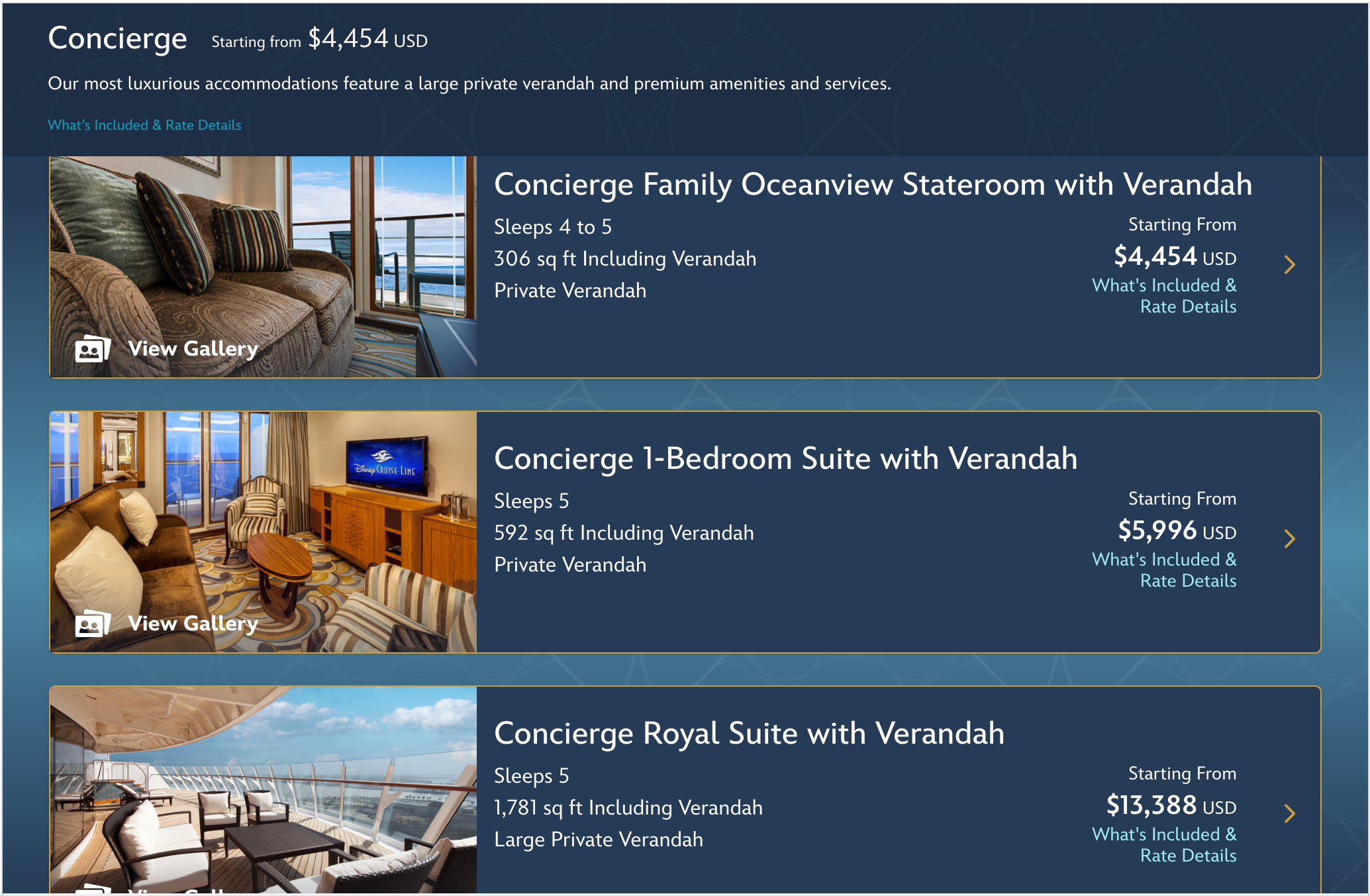
Disney Cruise Line concierge rooms traditionally start at the Oceanview Stateroom with Verandah level, and they will be clearly labeled as concierge rooms when booking. However, some rooms without verandahs, such as the Oceanview Staterooms on Disney Wish and Disney Treasure, can fall within the concierge class, too.

DISNEY CRUISE LINE

If you’re looking for more space, the ships have one- and two-bedroom layouts and specialty suites like the humongous 1,966-square-foot Tower Suites on Disney Wish and Disney Treasure. As previously mentioned, all Disney Cruise Line suites come with included concierge access and services.

Living room of Disney Wish Tower Suite with lofted second level and large windows
Tower Suite on Disney Wish. SUMMER HULL/THE POINTS GUY

If you're curious, here's a look inside the two-story suite on Disney Wish.

On Disney Wish, we weren't in that suite but did qualify for concierge access by sailing in a 608-square-foot, one-bedroom suite just a few doors down from the concierge lounge.

It had a master bedroom with a king-size bed, a gorgeous bathroom with a "Tangled"-inspired mosaic over the bathtub, a living room with a couch that converted to a bed, and a dining area with a table for four. The divider between the living and dining spaces contained a Murphy bed that pulled down into an additional single bed. The suite more than comfortably slept my two kids, my mom and myself.

Living room on Disney Wish. SUMMER HULL/THE POINTS GUY

A few years earlier, we had a slightly larger 614-square-foot one-bedroom suite on Disney Wonder that also conveyed concierge benefits. This suite felt more spacious than the one on Disney Wish, though it clearly had a more traditional look. In both cases, we were royally spoiled with more space and service compared to staying in a standard cruise cabin.

One-bedroom suite on Disney Wonder.
One-bedroom suite on Disney Wonder. SUMMER HULL/THE POINTS GUY

Related: The ultimate guide to choosing a cruise ship cabin

How much do Disney Cruise Line concierge rooms cost?

Cruise prices vary dramatically, and that’s especially true when you add concierge benefits with Disney Cruise Line.

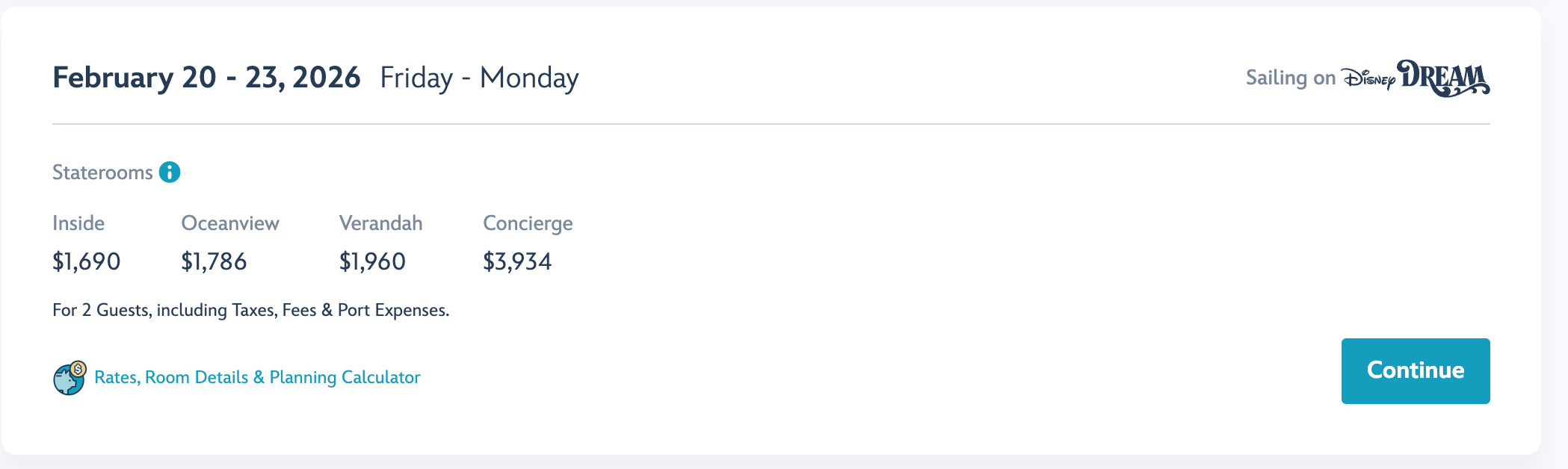
Currently, prices for a three-night Disney cruise from Florida to the Bahamas (including a stop at Disney’s newest island destination, Lookout Cay at Lighthouse Point) can start around $1,690 for double occupancy or $2,937 for a family of four in a windowless inside cabin. On the same cruise, a nonconcierge balcony cabin starts at $1,960 for two or $3,237 for four.

The lowest-level concierge room (with a verandah) starts at $3,934 for two or $5,757 for a family of four.

For that extra $2,000-ish, you get a little more time on the ship, the ability to book activities early with no stress, complimentary evening drinks in the lounge, snacks at the ready and free popcorn at the movies. Spend even more on a suite, and you can enjoy extra perks, such as hot room service breakfasts.

DISNEY

For travelers who really enjoy lounges, streamlining all the processes, having access to free-flowing drinks and having the highest level of service, I’d argue that a concierge-level cabin can be worth it for a special occasion or once-in-a-lifetime splurge.

On the other hand, for a seven-night Alaska cruise for a family of four, prices start around $7,000 for an interior cabin; a verandah room is more than $11,000, and a concierge room currently starts at a staggering $20,000-plus. In that case, you’ll probably never find me in a concierge room simply due to the cost.

DISNEY

Related: How to book a cruise using points and miles

Is Disney Cruise Line concierge level worth it?

You don’t need to spend the extra money on a concierge room to have a great cruise with Disney ... and trust me on that; I've sailed on all the ships and in cabin types ranging from an interior windowless cabin to a concierge suite.

It’s already a premium cruise experience. But if you are debating whether the concierge level is worth it, I’ll try and help you decide.

For us, the biggest perks were the advance booking for meals and activities that wouldn’t have been easy for a regular Disney cruiser to secure. The evening lounge drinks, free popcorn at the movies, extra touches like sunscreen readily available and help from the concierge staff when we had last-minute plan changes (which happened a few times) were also pretty great.

The private outdoor deck for concierge guests on Disney Wish and Disney Treasure is also a welcome addition.

Deck top pool
Deck-top pool. SUMMER HULL/THE POINTS GUY

I’d 100% book Disney concierge level again if my budget permitted and would say it can be worth it — mostly on the shorter cruises where every minute matters more than it would on a seven- to 10-night cruise. Additionally, on those shorter cruises, you are more likely to prioritize the evening lounge happy hours and drop in a few times to take advantage of the snacks.

Those shorter cruises also offer fewer opportunities to fit in the adults-only restaurants, spa treatments, drink tastings and onshore activities, making the booking-window advantage more important. If the budget allows, I’d seriously consider buying up to Disney’s concierge level on a three- or four-night sailing where I care about accessing specific restaurants and activities.

However, unless money really is no object, I wouldn't usually recommend the concierge level for your first sailing on one of the larger Disney ships, such as Disney Wish, Disney Treasure or the upcoming Disney Destiny. That’s because you might feel compelled to spend your leisure and premeal times in the concierge lounge when you should be out exploring all the amazing things the ship has to offer, including the food and entertainment at Disney’s no-fee restaurants and bars.

It isn't worth booking a concierge cabin or suite if you aren't likely to spend time in the lounge, don't need help or a head start with bookings for the adults-only restaurants or private island cabanas, and aren't interested in the special snacks or included beverages in the lounge in the evenings.

However, if those benefits will enhance your vacation and you can budget for a Disney cruise with all the concierge perks, you’re in for a treat. Start packing your cruise bag and planning those excursions, and don’t look back.

Related reading:

Editorial disclaimer: Opinions expressed here are the author’s alone, not those of any bank, credit card issuer, airline or hotel chain, and have not been reviewed, approved or otherwise endorsed by any of these entities.


from The Points Guy Articles https://ift.tt/BLoqgZs

Mid-tier refreshes, transfer ratio devaluations and more: TPG's credit card experts predict 2026 trends

With the sun setting on 2025, we've been musing on what new and exciting changes for credit cards, points and miles may arrive in 2026. The past year featured enough product launches, card refreshes and program changes to make our heads spin, so we're eager to see if that momentum continues into the new year.

I reached out to some of my fellow credit card experts here at TPG to see what they think about the ways our industry might change in 2026. Here are our thoughts.

Refreshes of mid-tier credit cards

2025 ushered in refreshes of three of the most popular premium credit cards on the market: the Chase Sapphire Reserve® (see rates and fees), the American Express Platinum Card® and The Business Platinum Card® from American Express.

With those out of the way, both TPG credit cards writer Augusta Stone and I believe we'll see issuers focus on their mid-tier products next.

Man making an online purchase at home
XAVIER LORENZO/GETTY IMAGES

I anticipate Chase to turn its attention to the beloved Chase Sapphire Preferred® Card (see rates and fees). We'll likely see an annual fee increase up to around $150, and at least one or two new statement credits to account for that.

This would be in line with what we've seen Chase do before, such as when it refreshed the United℠ Explorer Card (see rates and fees) and increased its fee from $95 to $150 (after the first cardholder year).

In Augusta's opinion, the American Express® Green Card definitely "needs a refresh." She noted that the Amex Platinum and American Express® Gold Card both received refreshes in the past couple of years, so it makes sense for it to be the Amex Green's turn. The Amex Green's loss of its LoungeBuddy benefit without a replacement makes Augusta think Amex may be ready to give it a new coat of paint.

The information for the American Express Green Card has been collected independently by The Points Guy. The card details on this page have not been reviewed or provided by the card issuer.

Continuing devaluations of loyalty program transfer rates

Worsening transfer ratios are a relatively new trend this year, albeit an unfortunate one. Amex and Citi both devalued their Emirates Skywards transfer ratios. Plus, Amex announced a coming reduction of its Cathay Pacific Asia Miles transfer ratio.

Lead writer Katie Genter and senior writer Ben Smithson — two of TPG's top points and miles experts — believe this trend will continue into 2026. Ben labeled it "worrying" and said he fears it will become more widespread.

Katie agreed, but while she suspects some programs will continue to change transfer ratios to be less than 1:1, she also believes that Chase will maintain a 1:1 ratio for all of its programs, as it's a point of pride for the issuer.

woman at computer
FRESHSPLASH/GETTY IMAGES

The development of transfer ratio devaluations underscores a point we often make here at TPG: Don't hoard your points and miles. You never know when they'll become less valuable, so redeem them for travel now.

Increased emphasis on issuer travel portals

We've seen issuers show a more vested interest in their travel portals this year — particularly Chase. Alongside its refresh of the Sapphire Reserve, Chase introduced Points Boost to encourage eligible cardholders to make more bookings through its platform, Chase Travel℠.

SOMYOT TECHAPUWAPAT/GETTY IMAGES

Augusta and Ben both believe that we'll see this turn into a proper trend in 2026. Ben said that with card issuers' travel portals becoming more complex, he expects to see more incentives, like high redemption values to book within the card issuer's ecosystem rather than transfer externally.

He warned, however, that cardholders should remember that it can be more expensive to book through a travel portal.

Augusta believes that Points Boost will ignite a new issuer initiative to launch competing benefits. She highlighted Amex, Capital One and Citi as the likely contenders to release a perk that competes with Points Boost. I expect Amex to be the first to bat with this, since it's Chase's closest competitor.

More dynamically priced awards, less time to snag them

Most airline loyalty programs use dynamic pricing at this point, but we largely haven't seen them use it for tickets that aren't on their own metal.

Ben believes we'll see this occur on a larger scale in 2026. He noted Air Canada Aeroplan's use of dynamic pricing for United and Emirates awards as a good example. He views this as a potentially negative development, warning that we could see long-haul first class Emirates flights as high as 400,000 points for a single flight, for example.

Woman with bills
NATALIA GDOVSKAIA/GETTY IMAGES

Alongside the looming threat of astronomically priced awards, Katie thinks we'll have less time to snag the redemptions we want. She's seen a trend of award availability disappearing rapidly, even if she acts immediately upon receiving an availability alert. With more and more people investing in points and miles, Katie said it'll only become harder to find good value redemptions.

Still, though, she encourages everyone to stay on the hunt for good deals.

Card launches galore

While 2025 did see the launch of a handful of new credit cards, the news cycle felt largely dominated by prominent card refreshes. 2026 could very well demonstrate the opposite, with high-visibility product launches.

I'm expecting Chase's highly anticipated premium World of Hyatt card to arrive in 2026. As someone who predominantly stays with Hyatt, I'll be paying close attention to any movement here.

THOMAS BARWICK/GETTY IMAGES

Bilt has already confirmed major changes to its credit card lineup as it shifts to a partnership with Cardless. Given Bilt plans to launch three brand-new cards as part of its Cardless debut, it's very likely its new suite of card products will become one of the biggest talking points of 2026.

The information for the Bilt Mastercard has been collected independently by The Points Guy. The card details on this page have not been reviewed or provided by the card issuer.

Augusta also thinks we may finally see Chase launch a proper competitor to the Amex Gold. This is something I've been asking for as long as I can remember, since the Amex Gold currently lacks a true competitor from any of the major issuers.

Related: Why Chase needs a competitor to the Amex Gold

More welcome bonus restrictions

We saw Chase undertake an initiative this year to restrict the ability of existing and previous cardholders to earn fresh welcome bonuses on consumer Sapphire and certain Ink products. Capital One also made it harder for certain people to earn bonuses on its Venture products.

Katie believes we'll see this unfortunate trend continue, with issuers prioritizing family rules and personalized offers. For example, I believe we could see Chase expand its recent restrictions on Sapphire and Ink welcome bonuses to their cobranded cards.

We may also see other issuers adopt American Express's strategy of offering a range of welcome offers for individual cards, versus a fixed offer.

Friends shopping at home
PEKIC/GETTY IMAGES

Additional restrictions on lounge access

Lounge access is one of the most beloved benefits on credit cards. In recent times, we've seen issuers place restrictions on access, such as Capital One's upcoming rule changes for its Capital One lounges. While frustrating for cardholders, these changes are a response to growing complaints about wait times and overcrowding.

Outside of JFK Capital One lounge
ZACH GRIFF/THE POINTS GUY

Katie thinks that we'll continue to see lounge owners place restrictions on access. She noted that while lounge access is a favorite benefit, once you have it, you may run into long lines or crowded lounges, which isn’t a premium experience. For that reason, she sees lounge owners prioritizing ways to limit access and reduce crowding.

AI infiltrates credit cards

Associate credit cards writer Stephanie Stevens has been musing a lot on AI. She believes that credit card issuers will start using AI to assist them with creating targeted, dynamic welcome offers for prospective cardholders. She also thinks AI will be used to manage lounge waitlists and overcrowding.

Young African man upset about phantom award space
DELMAINE DONSON/GETTY IMAGES

Of course, introducing AI into anything raises security and privacy concerns, especially when it is granted access to sensitive financial data. It remains to be seen where and how issuers will embrace these tools.

Bottom line

2026 is sure to be an exciting year. We expect plenty of attention-grabbing developments — some positive, some negative. Regardless of what happens, one thing remains the same: Points and miles are the best way to unlock amazing travel experiences.

We'll still be here to help you do that, no matter what next year brings.

Editorial disclaimer: Opinions expressed here are the author’s alone, not those of any bank, credit card issuer, airline or hotel chain, and have not been reviewed, approved or otherwise endorsed by any of these entities.


from The Points Guy Articles https://ift.tt/1Xrcnf8